On the Cost of Abundance
The first principle is that you must not fool yourself, and you are the easiest person to fool. - Richard Feynman
It ain't what you don't know that gets you in trouble. It's what you know for sure that just ain't so. - Mark Twain
We are in a highly unique time and place in history. Beyond the normal course of events that transpire through human history – war, inflation, political change – we also are in a time of rapid technological evolution and capital markets proliferation. These changes, each seemingly digestible in a vacuum, have all coalesced in this time and place, and this week, the markets have begun to show signs of stress.
Market participants over the last 4 years have been inundated with the AI buildout – increasing concentration in both equity and debt markets crowding out other companies raising capital, navigating disruptions to companies seemingly uninvolved with AI in any direct sense, and trying to manage risk in an increasingly correlated market. This month though, amid a seemingly unending stream of capital raises forthcoming, markets are starting to ask questions, and those questions are being answered via the cost of capital.
On the Cost of Capital
Numerous pages of ink have been spilled on the cost of capital so I don’t want to belabor it. Effectively, it is the price of time charged for a given duration of time and often for a given use case. The cost of capital is all based on the cost of risk-free capital which is government debt (given they can and literally do print money).
Government debt costs, at a very high level, are driven by the underlying real growth of the economy (a function of population and productivity), and a number of risk premia including but not limited to inflation, term risk (solvency risk), and country specific risk premia (for non-US).
By all historical accounts, debt costs are still largely below what would otherwise be considered normal. There are a number of reasons for this including proliferation of private markets which have added to the bid of the marketplace, as well as foreign investors seeking safe havens in the US dollar.
So, what is happening right now?
Brave New World Meets Cruel Old Rules
The AI buildout promises to create an Age of Abundance which very well may be true – as a generalist investor, I don’t want to claim any technological specialization here.
What doesn’t get discussed nearly enough today is the physical and monetary constraints on capital cycles. Having trafficked through enough SMID-cap cyclicals, I have a hard time believing anything is “no longer cyclical”, as many memory company followers have touted.
This cycle is not only an outlier in terms of its absolute impact to GDP, but also in the pace of the investment cycle. See the table below from the NBER: it took the railroads 20yrs to reach a 224bp GDP contribution, compared to the AI buildout which is projected to be ~322bps over just 7 years.
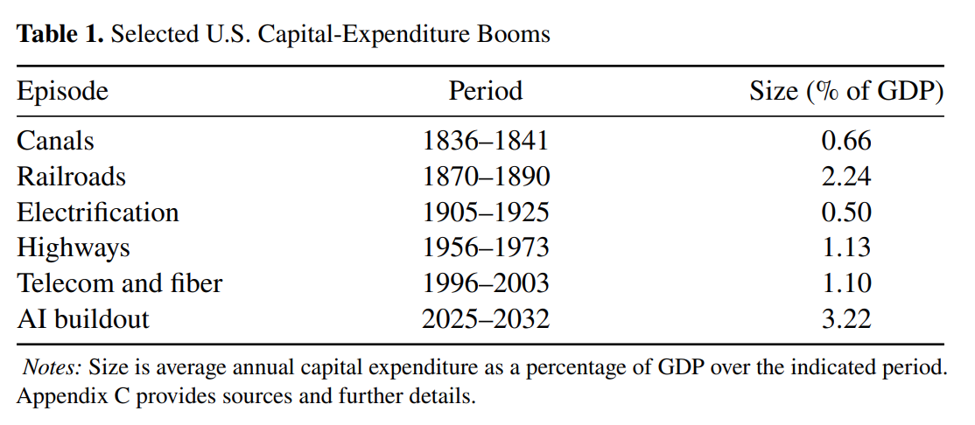
Source: NBER Working Paper 35865, 10/2026 p.5; https://www.nber.org/system/files/working_papers/w35865/w35865.pdf
As the industry moves from contractual commitments and offtake agreements to actual construction and delivery, physical constraints have appeared: physical materials, regulatory red tape and moratoriums, and most recently, the supply of monies. This creates a growing mismatch between capital commitments made today and an investment timeline that continues to extend, both as physical constraints appear and as more companies commit incremental capital to compete at the technological frontier.
These financing pressures are also emerging alongside an extreme level of index concentration in equity markets and growing concern of concentration in credit markets even as FCF dynamics have deteriorated across the previously highly cash-generative businesses with net cash balance sheets.
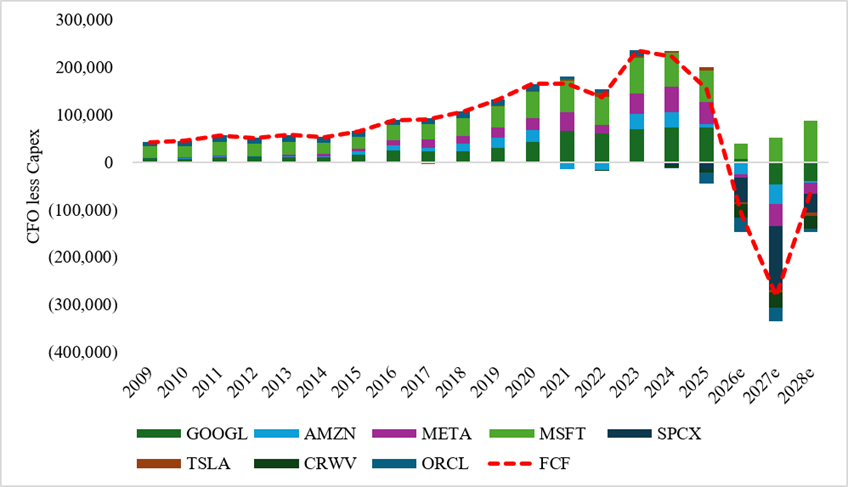
Source: Bloomberg, consensus estimates as of 10/24/2026
In the face of a large quantum of investment paired with an uncertain delivery timeline and physical constraints (including monetary), current demand can’t bridge an asset-liability gap of this magnitude.
Credit Infants Face a Recalibration
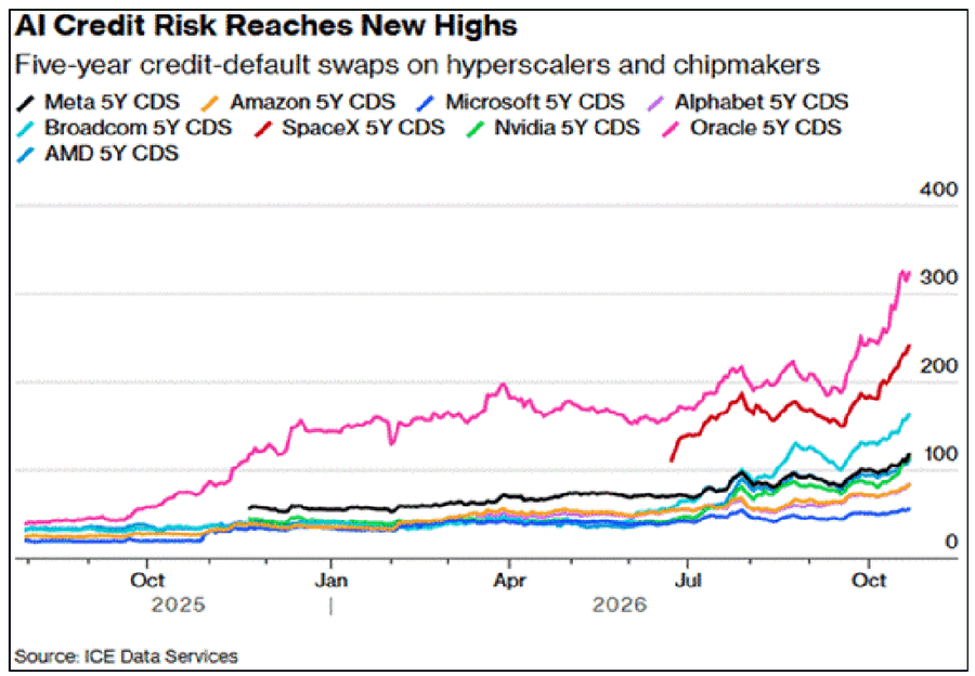
Over the last couple weeks, credit markets have hiccupped, with HY spreads up ~30-60bps since September month-end. Partly driven by increased focus on the asset liability mismatches at the neoclouds like CoreWeave, as well as what I would call a “general skittishness” regarding the upcoming quantum of capital raises and the mix of that capital (equity/debt), markets are increasingly asking more to finance incremental raises. Activity in credit default swaps (CDS) also highlight the growing liquidity risk here (see below).
More interesting to me though, is the recent move in UST v. corporate credits. As Fed pricing has recalibrated, the UST curve has come in some, while the corporate credit markets (from IG to HY) have begun repricing higher (vs. falling in tandem with base rates). See below short term data on UST10Y rates compared to an implied HY rate (comprised of the UST10Y + HY OAS spreads) on the left. This to me is the biggest signal that the cost of capital has increased on the margin. On the right, I plot daily changes in UST10Y rates and the implied HY rate, where you see in red the October 22 session. One trading day hardly makes a trend, but it does suggest a divergence between the HY rate and underlying risk-free that is worth tracking.
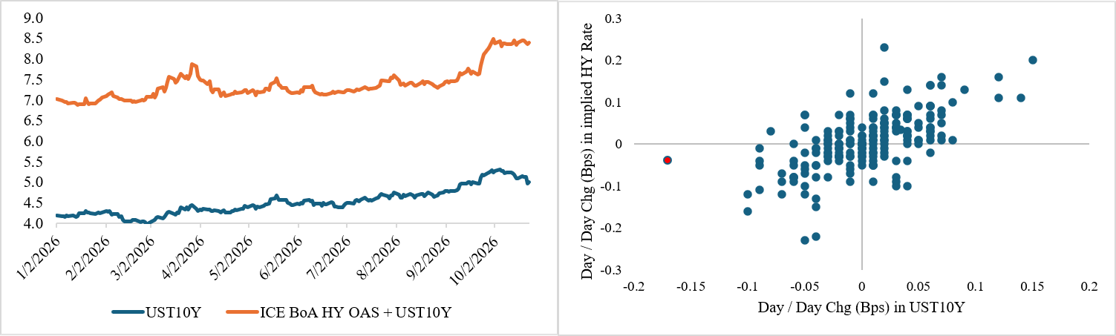
Source: FRED data, WCMC analysis; NOTE: Implied HY Rate = UST10Y + ICE BoA HY OAS; Data as of 10/23/2026.
An underappreciated element of this cycle is the relative immaturity of these companies in terms of dealing with credit markets. The credit market tends to be more of a “stickler” vs. the equity market that tends to “dream the dream”. Further, the financing channels have changed since the GFC, with a much higher proportion of financing coming from private capital (compared to a highly regulated banking system).
To be very clear, I am not calling for a top or anything, I am saying that I will be closely watching incremental capital raises and the terms of said financings as the incremental cost of capital is akin to the music stopping in a game of musical chairs. Markets have a way of awaiting the final raise, which if left unclear by the builders of this cycle, can create tension and increased volatility.
Quick Thoughts on the Human Perspective
Something not spoken about nearly enough in my view is the societal impact this technology will undoubtedly have. The CEOs of these model companies are actively speaking to their technology’s ability to disrupt the world across many functions of society that we as a culture take for granted – water, power grids, internet protocols, digital finance/payments, healthcare/biotech, warfare – but we are rushing toward an automated world where digital intelligence far surpasses human ability to understand. It’s truly one of the only cycles I can remember where we are bidding for a technology that is almost promising our demise.
I am not meaning to sound like a luddite or a doomer, but I wonder whether the market is beginning to price risks that extend beyond the immediate needs of the buildout. We are spending unfathomable amounts of capital toward a thing that will displace human operations. When spending approaches these magnitudes of GDP, social contracts are bound to change, but that isn’t part of the zeitgeist today.
What happens if 50% of white collar jobs disappear? What happens to consumer spending which is 70% of GDP if 30% of the labor force loses work? Can the government finance a social safety net? Who bears the legal liability for the actions of autonomous AI agents? What does the social contract look like in a world where a few companies produce intelligence that surpasses 99% of humanity? What happens if a rogue entity takes control before regulatory ability to keep up?
These are the key questions in this cycle. And some of the answers could be the very undoing of the thing we are financing at this very moment in time. Ultimately, these uncertainties are precisely why capital allocation and price discovery matter: no amount of technological promise can exempt an investment from scrutiny of risk, cost, and returns. This is what makes America great, and what has made Capitalism the most dynamic and most fruitful economic system in world history – price discovery in open markets.
Member discussion