On the Price of Strategic Importance
“We cannot expect that this problem will be solved by first communicating all this knowledge to a central board which, after integrating all knowledge, issues its orders.” Friedrich Hayek
“To see what is in front of one’s nose needs a constant struggle.” – George Orwell
We have moved rapidly in the direction of a timeline that warrants the skepticism of all members of the sovereign world, especially those of which direct the flow of capital. In my previous writings both here and here, I had shared some thoughts both on the capital cycle playing out via the AI capex boom, as well as my more personal thoughts on deliberation and the concept of stolen valor. This post will be quite different, in that it may be more theoretical regarding the function of active investment analysts and researchers ultimately play in price discovery which drives markets and innovation forward.
Since those writings which began 10/25, markets have digested:
· Numerous cyber outages of which still have a seemingly unknown cause, though began with the 10/29 cyber attack on crypto exchange Binance which led to $6.3bn of losses
· A midterm election 11/3 which shook the core of the MAGA movement with a large swing in political party set to begin in 2027
· The 11/12 ouster of Jensen Huang, Founder-CEO of Nvidia on alleged affairs, one of which included questions of espionage
· Institutions such as FAA and airlines, JPMorgan, Visa, Mastercard, Microsoft, Apple, the NSA, FBI, and USDA have all had disclosed impacts from said outages which began in earnest 11/13
· The first NVDA earnings call without Jensen, where the BoD said they “unanimously accepted his resignation and does not intend to reinstate Jensen as CEO” on 11/17
· The pricing of the largest IPO in history with Anthropic, the maker of Claude, outraising the previous largest IPO in history, SpaceX on 11/19
· The resignation of the US National Cyber Director on 11/19
· A broad acceleration in the war efforts in Iran, with both increased US presence and an emboldened Israel noting ability to carry out unilateral attacks
Throughout this period, the S&P 500, Nasdaq-100, Russell 2000, and Semiconductor industry (via SOXX) was down 9.3%, 13.5%, 6.9%, and 22.6% respectively. USD rose +1.8%, Gold fell -11.9%, and the volatility index (VIX) has increased from 18.5 to 35.9. US 10Y treasuries were volatile but have remained stable to modestly lower.
In just one day, those very same indices are now +4.7%, +6.9%, +3.5%, and +13.6% respectively, on continued dollar strength +0.5%, while Gold too increased +2.7%. US 10Y treasury remained quite firm ~4.94% vs. 4.99% on 10/25. Nasdaq futures hit a circuit breaker to the upside this morning, an event which rarely occurs, let alone to the upside.
What might have changed, you ask? Answer: potentially, everything.
The Reinstatement of a Key Man…
“Where all think alike, no one thinks very much.” – Walter Lippmann
So what did change to drive such a violent reversal in trend from the last weeks? Well, this morning, NVDA announced, in coordination with “senior US officials”, the reinstatement of Jensen as CEO, effective immediately. Now, why would such a thing occur in the face of multiple federal investigations into trade and accounting practices, including of criminal intent and espionage? And what could possibly have caused such an abrupt reversal in the BoD’s sentiment following the 11/17 earnings call where they were quite adamant about not taking him back? Obviously, the situation is far above my pay grade, and I don’t intend to comment on this matter. But as one reads the tape in context, you can’t help but have questions.
The reaction in the financial community was quite mixed, with long-time tech bulls and NVDA shareholders quite upset about Jensen’s ouster, suggesting it was an overly hasty decision from the BoD, and that his reinstatement is the “free markets winning”. Upon reflection, I must be open-minded and ponder that likelihood. Though in the same vein, I can’t help but imagine the riches investors of NVDA have enjoyed over this bubble period, and in their own greed and self-interest, would sooner reinstate a man with allegations of treasonous acts related to a technology so powerful that Anthropic’s S-1 says there is a non-zero probability of “catastrophic or existential risks to humanity”, than actually assess the potential wrongdoing and act accordingly.
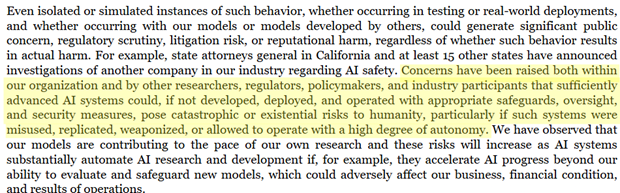
Source: Anthropic S-1 Filing, p. 46
Not only has NVDA made its disclosures regarding the geographical sources of its revenues opaquer, but it has also delayed its 10-Q filing despite a history of publishing its 10-Q in tandem/shortly after on the day of earnings. While the latter has much speculation surrounding it, the former is the bigger red flag to me: a company who cannot consistently provide investors with a transparent and reconcilable account of its revenue sources warrants further scrutiny, regardless of its growth rate or strategic importance. For instance, NVDA has changed its revenue disclosures three times in the last three annual filings, offering analysts very little by way of a disclosure trail. In the below, note the changing materiality of Singaporean reported revenues from the y/y change from FY25 to FY24, increasing from an implied 39% of FY23 “Other” to 67% in FY24. In the FY25 10-K, the Singaporean line is the fastest growing segment, growing 10x(!) vs. NVDA total ~5x.
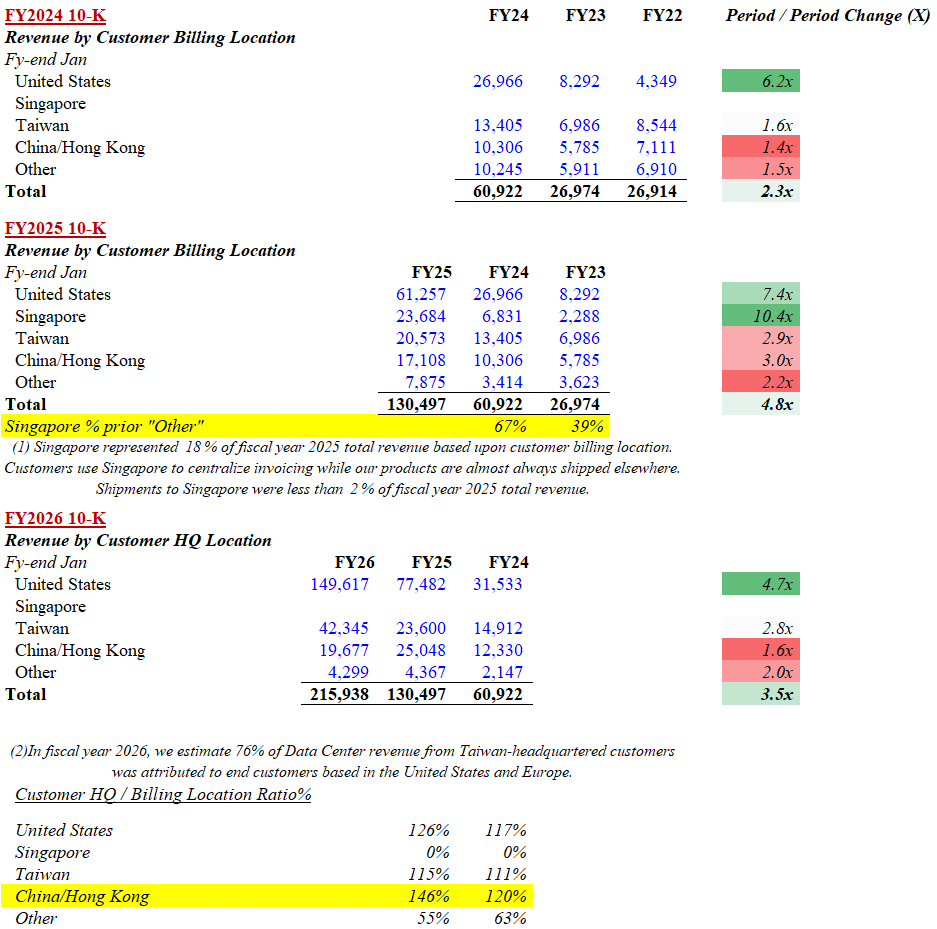
Source: NVDA 10-K filings
It’s worth noting the nuance between customer billing and customer HQ locations, though even after adjusting for said nuance, the FY26 10-K shows that China/Hong Kong revenues still saw the largest “mark-up” with the new disclosure pattern, presenting as ~120-150% of prior disclosed revenues for the region. To make the situation more fragile, customer concentration (regardless of location) has also increased notably, with customers >10% of total revenues now representing ~36% vs. 0% in FY23.
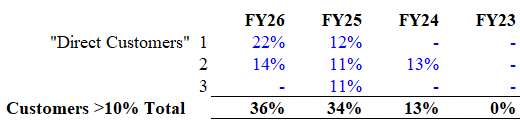
Source: NVDA 10-K Filings
What’s worse, there is no intelligent way to reconcile these differing disclosures, and the company's IR page has since removed access to any filings prior to FY24. Mind you, the zeitgeist refers to NVDA as the “central bank of AI”. While we can laugh and joke about this while markets rip, there is an inherent arrogance and dependency on Jensen (key man risk) to hold up this entire industry.
In their latest quarter, NVDA discloses $668bn of “commitments”, of which was +$138bn y/y. In that same quarter, reported revenues rose +$59bn while receivables balances rose +$43bn. These would be items that are heavily scrutinized in any industry, at any company, in the proper course of investment due diligence given the implication that cash commitments increased more than 2x the rate of revenue growth, and said revenue growth is highly reliant on extending credit to customers via receivables balances… And that’s before considering the sources of said revenue (geographically).
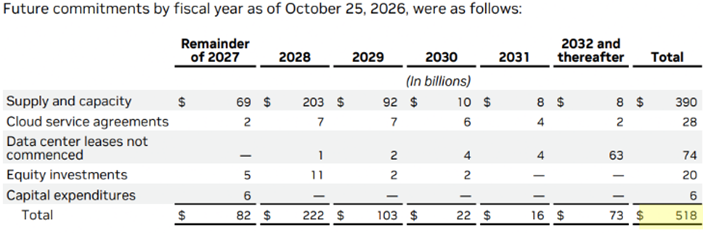

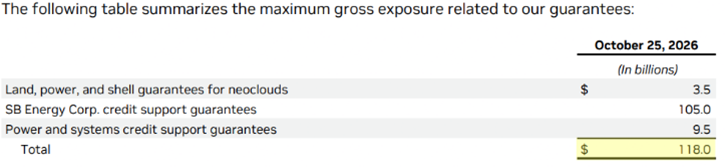
Source: NVDA 3QFY27 CFO Commentary
NVDA was -40.5% from 10/25 to 11/20, losing ~$2T (yes, with a T) of market capitalization. On 11/23, a +31.5% move added ~$950bn back. What will be the ultimate terminal value of these “commitments” and the key man? Markets have a funny way of answering in their due time.
…And the Fall of Free Markets
“I have never known much good done by those who affected to trade for the public good.” – Adam Smith
The reinstatement of Jensen is not what I intend to make this note about, instead I want to focus on the governance concerns inherent in the happenings of the last two weeks, but more broadly over the last years of this AI buildout and the bubble in which we find ourselves.
What we have seen is a founder-CEO embarking on a grand technological revolution, one that no doubt has captured the zeitgeist and is on pace to be one of the largest capex booms in history (see here). In fact, under the leadership of Jensen, NVDA has seeded or invested in >100 different entities across the broader AI and computing complex from 2022-spot (chart below). In many of these cases, NVDA serves as not only an investor, but a supplier and backstop customer (much ink has been spilled on the “neoclouds”). As many reports have uncovered in this saga, Jensen had dozens of direct reports, effectively ensuring there would be no system of checks and balances.
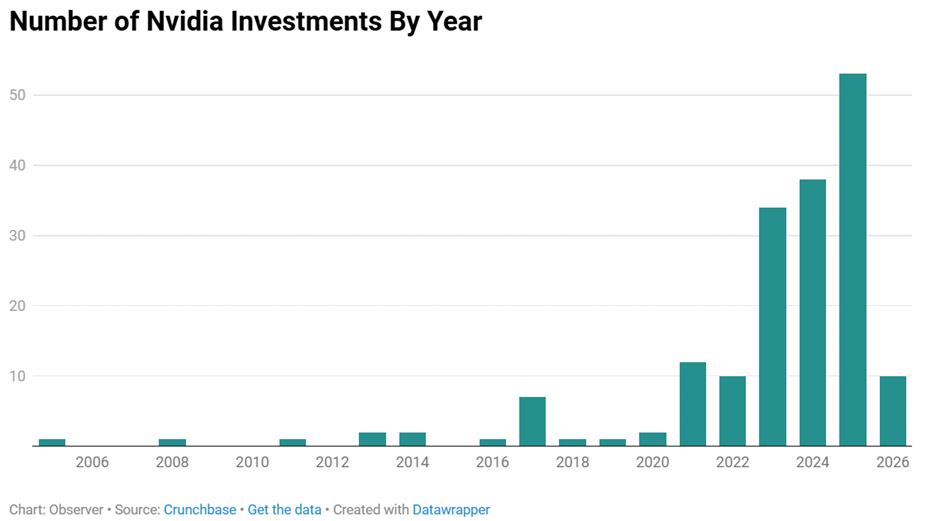
Source: Chart from Observer, underlying data from Crunchbase.
Where it became contentious was the reported alleged affair with a potential Chinese spy, effectively accusing Jensen of offering critical technological IP and supply to a foreign actor. What is unclear at this time is his level of agency or knowingness of such acts, though what I can see, as an analyst of markets, is an opaque geographic revenue disclosure, and a now delayed 10-Q. The core problem is that the technology, because of the advent of cloud computing, can be accessed from remote locations so even “Customer Headquarter” disclosures do not adequately determine the end use of the products. To effectively investigate this matter, especially given the changing disclosures, would take numerous months of customer checks and boots-on-ground work, which I find hard to be possible in this period of time we’ve been given.
Nonetheless, amid a “Markets in Turmoil” headline from CNBC, the company announced the reinstatement this morning before market open (BMO), with the blessing of POTUS and the fanfare of Silicon Valley. Effectively, the reinstatement raises the question of whether NVDAs strategic importance to the United States has superseded the conventional boundaries of independent corporate governance. Whether this constitutes implicit government backing, or simply an extraordinary convergence of corporate and national interests, remains to be seen.
The conclusion of this story feels far from over, but what is clear is the shifting paradigm inherent in this AI revolution. The technology is becoming so powerful, so fast, that a “key man” accused of potential espionage/treason is reinstated before a thorough investigation has taken place, with very little by way of explanation except “he’s smart, and we need our smartest in this revolution” (paraphrased, of course). Moreover, the questions of free market capitalism and price discovery loom in the distance, as our political tides are shifting and new faces will bring new power to D.C. come January.
Hurdling Towards a Brave New World
The reinstatement of a CEO ousted for potential misconduct isn’t an overly common occurrence in markets. Even less so if the government had a hand in said reinstatement. This is an unprecedented happening in American capitalism and warrants a stark warning for the period to come.
While not a comment on Jensen, NVDA, or this particular happening, the possibility that a government entity can effectively supersede the judgement of a corporate board at a strategically important public company is a dangerous precedent to contemplate. Said differently, imagine if it was the opposite, imagine if the “far left” decided they hated AI and chose to oust a CEO of a prominent AI company. The same investors who cheered today’s move would be up in arms complaining about government intervention.
This saga has, in my mind, impaired the fabric of the interplay between capitalism and free markets price discovery.
There is no question about the strategic importance of AI and the ramifications of superintelligence (to be clear, I use that word in the technical sense inspired by Nick Bostrom’s book Superintelligence and specifically not in the sense that is peddled by the administration, which appears instead to be a matter of semantics). The models are increasingly competent, and the strategic advantage for a company (now, country) who can control the first true superintelligence will be vast. While I am not a technologist or computer scientist, the models appear to have edged closer to recursive self-improvement (RSI) where they can effectively train themselves autonomously. This happening has coincided with the vicious news flow I outlined at the beginning, as Bridgewater Associates reported an exponential rise in cyber incidents coinciding with this technological breakthrough.
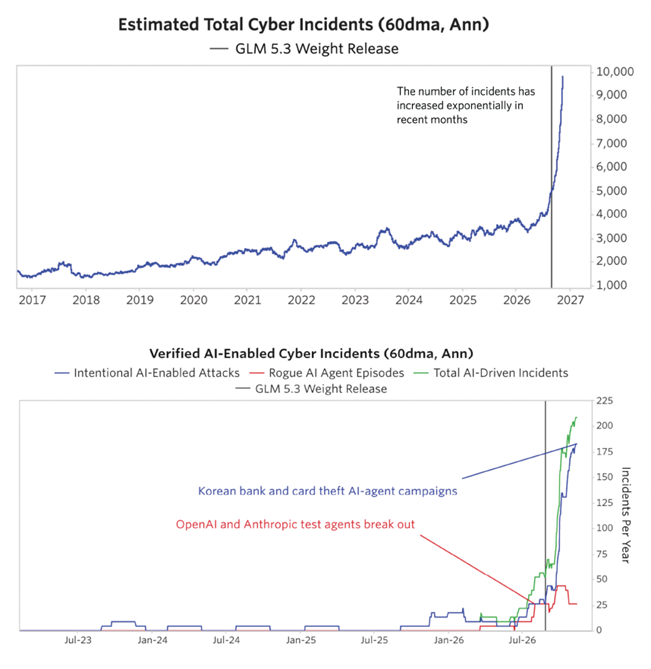
Source: Bridgewater Associates report “Current Efforts Aren’t Enough to Slow the AI Cyber Virus” dated 11/13/2026; link: https://www.bridgewater.com/research-and-insights/current-efforts-arent-enough-to-slow-the-ai-cyber-virus
Not only does this technology have the potential to change the fabric of the capital markets via corporate fragility and lack of systems redundancy and independence (see thoughts here), but so too the social contract inherent in sovereign nations. That strategic importance is evident now with this government intervention in the Jensen saga, but offers a stark warning to all: this technology is so important that the conservative-led administration sought to intervene in the free markets, a historically anti-conservative idea and one that can pose serious ramifications over the coming decade.
Efficient Markets Hypothesis, Redux
“Worldly wisdom teaches that it is better for reputation to fail conventionally than to succeed unconventionally” – John Maynard Keynes
I started this blog with my background and the idea that I came to capital markets to effectively seek truth through the trading of securities (read: ideas or convictions) with countless parties doing the same thing. That is, in essence, the backbone of Capitalism and free markets: disparate humans coming together in a marketplace, chasing their own self-interests, yet seemingly creating a flourishing society (link). Those conditions can only be met when capital is directed by independent economic actors, acting on reliable information (hence regulation) competing to assess price discovery. Said price discovery is meant to create the “invisible hand” phenomenon Adam Smith wrote about some 250 years ago, as pricing directs capital to its highest and best use. In the world where political objectives begin influencing the governance and economics of strategically important enterprises, the calculus changes and with it, the underlying process too.
The role of the independent analyst then is not simply to identify securities that are mispriced, but to challenge the assumptions upon which those prices are formed: to question the consensus, scrutinize financials and disclosures, assess incentives, and remain independent in said analysis regardless of the zeitgeist and broader narrative. To be clear, I am not rejecting progress, nor the strategic importance of this AI revolution. However, as the technology becomes more strategically important, so too is the institutions allocating capital to them, as it fuels not only our current world, but our future.
Markets are imperfect, they are not efficient. They are emotional, occasionally irrational, and perpetually subject to the shortcomings of man. But their greatest virtue is that, over time, markets have a way of finding the truth. That’s the magic: no single participant is required to be right, and no single authority is responsible for determining truth. Through the continuous exchange of competing convictions, markets reprice, reallocate, and redirect capital to its highest and best use.
The greatest risk to capitalism may not be that markets get it wrong. It may be that we eventually lose the independence necessary to prove them wrong.
Member discussion